Establishing a Business in the Netherlands in 2026
The Netherlands: Strategic Entry & Operations
Over the last decade, we have helped hundreds of foreign businesses and entrepreneurs establish their presence in the Netherlands. This guide is the direct result of that work.
In almost all scenarios, setting up a BV (limited company) is the professional standard. In most cases, owning the shares through a holding BV is recommended. While freelancers may consider a sole proprietorship, it is becoming less attractive for international growth. For e-commerce and trading, we often implement fiscal representation combined with Article 23 VAT deferral to significantly optimize cash flow.
The Main Challenge: Substance
Setting up a subsidiary is rarely just about the registration. The hurdle is "substance": demonstrating sufficient economic activity to satisfy tax authorities and secure a local bank account. We specialize in building structures that meet these 2026 requirements.
For non-EEA entrepreneurs, residency options are precise. While HSM (High-Skilled Migrant) and Startup visas require significant dedication, American citizens can leverage the DAFT Treaty for a relatively streamlined and cost-effective residence permit.
Taxation remains highly competitive: the 30% ruling offers a massive tax cut for skilled employees (including owners!), while innovative companies can benefit from corporate tax rates as low as 9%.
Why the Netherlands?
Market Size & Gateway Position
| Country | Population | GDP per Capita | English Score |
|---|---|---|---|
| 🇳🇱 Netherlands | 18M | €60k | 90 |
| 🇩🇪 Germany | 84M | €57k | 63 |
| 🇫🇷 France | 67M | €49k | 60 |
| 🇧🇪 Belgium | 12M | €54k | 64 |
| 🇳🇴🇸🇪🇩🇰🇫🇮 Nordics | 27M | €52k–€80k | 67-72 |
The Netherlands is the 7th largest EU economy with the highest e-commerce adoption in Europe.
From our Amsterdam office: Foreign companies that set up in the Netherlands "just for EU access" consistently generate 30-40% of their revenue from the Dutch domestic market within the first two years. High purchasing power and digital adoption make it more than a gateway.
Two Reasons to Choose Netherlands
From our client base, we see two distinct reasons businesses choose the Netherlands: gateway position for EU market access, or a specific incentive that makes the Netherlands uniquely attractive.
Best Gateway to EU Market
Rotterdam is Europe's #1 port. From Amsterdam, you can reach 170 million consumers in Germany, France, Belgium, and the UK within a single day's truck drive. Formation takes 3-5 days.
→ Trading companies, e-commerce, logistics
Specific Incentives
The 30% Ruling cuts taxes for foreign talent. DAFT gives Americans residence with just €4,500 capital. Article 23 defers import VAT for cash flow. #1 English proficiency globally.
→ Expat entrepreneurs, US founders, tech startups
By Client Type - Your Situation, Your Roadmap
Step-by-step guides tailored to how you're entering the Dutch market.

The Dutch market offers different pathways depending on where you're coming from and what you're building. Select your situation below for a focused roadmap covering visas, entity structure, banking, and compliance.
— Thomas, NordicHQ Founder
+ American Entrepreneurs
The DAFT visa gives US citizens a unique fast-track to Dutch residency with just €4,500 investment.
• Visa: 2-year renewable residence permit, no sponsorship needed.
• Structure: Dutch BV or sole proprietorship (eenmanszaak).
• Timeline: Full setup in 6-8 weeks including IND application.
+ UK Companies Post-Brexit
Brexit ended passporting. UK companies now need a Dutch legal entity or branch for EU market access.
• Options: Dutch BV subsidiary, branch office, or full relocation.
• Substance: Real presence requirements to avoid permanent establishment risks.
• VAT: EU VAT registration restores B2B simplifications.
+ Contractors & Consultants
Independent professionals relocating for contracts or building a consulting practice from the Netherlands.
• 30% Ruling: Tax-free allowance for skilled migrants (salary threshold €46,107).
• Structure: BV recommended above €80,000 annual revenue.
• 183-Day Rule: Critical for determining tax residency when working across borders.
+ Tech Startups
The Netherlands offers strong startup incentives including dedicated visas and R&D tax benefits.
• Startup Visa: 1-year residence to develop innovative business with approved facilitator.
• WBSO + Innovation Box: R&D wage credits plus 9% tax on innovative profits.
• SAFE Notes: Dutch-compatible investment structures for funding rounds.
+ E-commerce & Trading
Europe's largest port and VAT deferment scheme make the Netherlands ideal for e-commerce logistics.
• Article 23: Import VAT deferral - no cash tied up at customs.
• OSS: One-Stop-Shop for EU-wide B2C VAT from a single Dutch filing.
• Fulfilment: 3PL infrastructure and Amazon prep services throughout Rotterdam.
Not sure which applies? Many clients combine elements - an American starting an e-commerce business, or a UK tech company needing startup incentives. We'll help you identify which pathway and structures fit your specific situation.
Business opportunities in the Netherlands
The Netherlands is a great place to do business, thanks to its strong economy and favorable business climate. There are many opportunities for businesses in the Netherlands, including in the manufacturing, agriculture and services sectors. The Dutch market is also well-connected with other markets in Europe and around the world, making it a good location for export-oriented businesses.
The best industries to start a business in the Netherlands vary depending on the specific sector and region. However, some of the most promising sectors for Dutch businesses include:
- IT products and services: If you are thinking of starting an IT business in the Netherlands, there are many opportunities waiting for you. The Dutch IT sector is thriving, with many companies offering innovative and cutting-edge products and services. In addition, the Dutch market is well-connected with other markets in Europe and around the world, making it a good location for export-oriented businesses.
- E-commerce: the Dutch market is very open to online commerce, with a extraordinarily high rate of internet penetration and a large number of online shoppers. In addition, the Dutch are comfortable making purchases online, and they are used to paying for goods and services with various payment methods.
- Agriculture: The Netherlands is a major producer of agricultural products, including meat, dairy, vegetables, and flowers. There are many opportunities for agri-businesses in the Netherlands.
- Manufacturing: The Netherlands is a leading manufacturer of machinery, chemicals, and other industrial products. If you are looking to start a manufacturing business in the Netherlands, there are many opportunities available.
- Services: The Dutch services sector is thriving, with many opportunities in sectors such as consulting, tourism, healthcare, and financial services. If you are looking to start a service business in the Netherlands, there are many opportunities waiting for you.

The Netherlands is a great place to do business, but there are some challenges that you need to be aware of. Although the country has some distinct advantages, it's important to understand both sides before making your decision.
Direct communication style
If you're used to more indirect communication styles, be prepared for the Dutch to be very direct. They value straight talk and honest feedback, so you may get some bluntness in return if you ask for their opinion. However, this culture of openness is also what makes the Netherlands such a welcoming and inclusive place. People here are quick to start up conversations and strike up new friendships, so don't be afraid to engage with people you meet. You'll likely find that the Dutch are warm and hospitable, despite their sometimes brusque exterior.
Complex tax system
The tax system is quite complex, so you will need assistance to get a clear understanding of the tax structure. There are a range of subsidies and tax deductions. The rates and credits will naturally vary depending on your individual circumstances. With so many factors to consider, it's essential to seek professional advice to ensure you're getting the most out of the system. However, by taking the time to fully understand the tax system in the Netherlands, you can save yourself a lot of money and stress in the long run.
Paperwork and red tape
When it comes to starting and running a business in the Netherlands, sometimes significant paperwork is needed. Much of the paperwork is still in Dutch and not always very friendly to those who are not familiar with it. Systems and processes can be a bit bureaucratic, and it can take a long time to get everything up and running. Chamber of commerce registration and opening a business bank account can be particularly time-consuming. However once everything is in place, you will be able to enjoy the benefits of doing business in this wonderful country.
Good news: The Netherlands might have some red tape, but it is still one of the least bureaucratic and corrupt countries in the world!
Regulated labor market
The labor market is highly regulated, and it's important to make sure you understand the rules and regulations around hiring employees. There are a number of flexible options available, including temporary contracts and part-time work. You can also use employment agencies to help you get started as well as longer term. However, it's important to remember that all employment contracts must comply with Dutch law. This means that you need to be clear about the rights and obligations of both employer and employee. Failure to do so could lead to legal problems down the line. So if you're thinking about hiring staff, make sure you take the time to understand the rules first.
Cost of living considerations
The cost of living in the Netherlands can be expensive, especially in big cities like Amsterdam. House prices and rentals are typically very high, and there is a high tax rate on income and consumption. As a result, it is important to realistically factor the cost of living into your business plans. There are a few ways to reduce costs, however. For example, a location in a smaller city or town, outside of the Amsterdam area, will be cheaper. Initially renting a furnished apartment can be a good starting point. In any case, make sure to budget carefully and track your spending.
Need help navigating these challenges? Contact us – we can help guide you through the maze and make starting up your venture in the Netherlands run much more smoothly.
Legal Structures
Establishing a business in the Netherlands involves choosing a suitable legal form. Options include sole proprietorship, partnership, and BV limited liability company.
However, only the BV can effectively be managed from abroad and offers a low corporate tax rate, making it popular. Foreign entrepreneurs can create a Dutch daughter company, set up a single BV, or form a BV holding structure. The latter, providing tax advantages and bankruptcy protection, is preferable if the Dutch entity isn't a daughter company of a foreign entity.
Dutch holding structure
The Dutch BV holding structure has two main advantages: lower risk-profile and a lower tax burden.
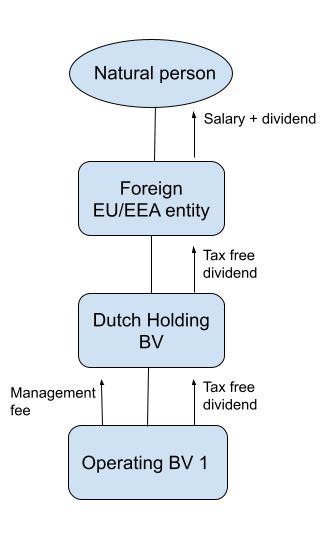
The business activity will take place in the operating BV. The holding BV will deliver 'management services' for the operating bv. Any profits made in the operating bv can be transferred as dividends to the holding BV without having to pay dividend tax. You will also not pay double profit tax over this profit. Plus, there is no inter-company dividend taxed, so this transfer is tax-free. In case of bankruptcy of the operating BV, your assets that you have "moved up" (cash, IP etc.) to the holding will be protected.
Also, if you one day sell the operating company, you will receive the profits from the sale in the holding where you can keep the money without paying additional profit or dividend tax over the sale. You can reinvest this tax-free from the holding into another entity. If you do not have a holding in place, the sales profit will be paid out immediately to yourself and you will pay much higher personal income tax over the sale profit.
Choosing Between a BV and a Branch Office
For a long-term presence in the Netherlands, a BV (Private Limited Company) is almost always the professional standard. While a branch is technically possible, it introduces several operational hurdles.
Branch Office
- Liability: No legal separation; the parent company is fully liable for all Dutch debts and risks.
- Tax: Complex "profit attribution" rules and transfer pricing requirements.
- Market Perception: Often viewed as a temporary commitment by local clients and banks.
Dutch BV
- Liability: Limited to the investment in the company; protects the parent entity.
- Compliance: Cleaner tax reporting and standard accounting procedures.
- Authority: Provides the legal clarity preferred by Dutch businesses and vendors.
UK Companies: Do you actually need a Dutch BV?
Many UK Ltd companies default to incorporating a Dutch BV for EU market access. However, if your primary need is importing goods and VAT compliance, fiscal representation with Article 23 VAT deferral is typically faster and significantly cheaper than full entity setup.
Sole Proprietorship (Eenmanszaak or ZZP) in the Netherlands
In the Netherlands, a sole proprietorship, also known as an eenmanszaak or ZZP (Zelfstandige Zonder Personeel), is a popular business structure for entrepreneurs and freelancers. This guide will walk you through the requirements, process, and additional documents needed to set up a sole proprietorship, as well as tax obligations and other important considerations.
Read more about the process below or request a free quote for setting up a sole proprietorship in the Netherlands.
Requirements for Setting Up a Sole Proprietorship in the Netherlands
Before starting the registration process, ensure you meet the following requirements:
- You must be at least 18 years old.
- You must be a resident of the Netherlands. This means you need a valid BSN-number. Especially the second requirement is often misunderstood by people contacting us. Whereas anyone in the world can start a private limited company (BV) in the Netherlands, the sole proprietorship requires residency in the Netherlands. Furthermore, if you decide to move from the Netherlands after you have successfully set up a sole proprietorship, the sole proprietorship can continue to exist. Such a decision will most likely lead to a change in your tax situation, so it is wise to consult an international tax advisor.
- You need a Dutch address for your business (a postal address is in most cases also acceptable). If you do not want or you cannot register at home, you can register an office address. If you do not have one, we can recommend you a few.
Registration Process
To set up a sole proprietorship, follow these steps:
- Choose a trade name: Your trade name should be unique and not misleading or offensive. A trade name check can be done through the Dutch Chamber of Commerce (KVK) website.
- Register with the KVK: Fill out the registration form and submit it to the nearest KVK office. You will need a valid ID and your business address. A one-time fee of €75 will be charged for registration.
- Apply for a VAT number: The KVK will automatically forward your details to the Dutch Tax and Customs Administration (Belastingdienst), who will then provide you with a VAT number (BTW-nummer) and a VAT identification number (BTW-id). Both numbers are essential for invoicing and tax obligations. It takes on average about a week to receive the VAT number.
Optionally, you can open a separate Dutch business bank account. It is allowed to use your personal bank account, but we strongly recommend you to keep your personal finances separate from your business. That is why a company bank account is useful. You can connect this bank account to an accounting program of your own choice and maintain your administration with just a few clicks.
Flipping point: Switching from Eenmanszaak to BV
The flipping point to choose a sole proprietorship (eenmanszaak) in the Netherlands versus a BV is when your business starts to grow and you need to protect yourself from personal liability. Once you are there, you can relatively easily transfer the eenmanszaak into a BV. There are several ways of doing this, explained in more detail in this article.
A sole proprietorship is a transparent entity, which means that you are personally liable for the company's obligations. This means that if your business goes bankrupt, you could be forced to sell your personal assets to pay off the company's debts. A BV, on the other hand, is a limited liability company, which means that you are not personally liable for the company's obligations. This means that if your business goes bankrupt, your personal assets will not be at risk.
Another factor to consider is the tax implications of each structure. A sole proprietorship pays income tax on the profit, while a BV pays corporate tax on the profit and dividend tax on the profit distribution. In addition, the BV must pay a salary to the main director-shareholder (DGA), on which the DGA pays income tax. Tax advantages such as the 30-percent ruling, can also make the BV a more attractive option, depending on the circumstances.
Finally, you need to consider the cost of each structure. A sole proprietorship is much cheaper to set up than a BV. However, the BV has a number of advantages, such as limited liability and tax benefits. Maintaining the BV is also more costly, mainly due to accounting and reporting costs.
Ultimately, the decision of whether to choose a sole proprietorship or a BV is a personal one. You need to weigh the pros and cons of each structure and decide what is best for your business.
Our professional business, legal and tax advisers can help you make the right decision.
General partnership - VOF
For some small businesses a self proprietorship (in Dutch: Eenmanszaak) or a general partnership (in Dutch: VOF) can be considered. The setup is simple and affordable, but depending on the business the tax and liability is often less attractive. Below you will find a comparison of the three legal entities: sole proprietorship (eenmanszaak), general partnership (venootschap onder firma or vof) and private limited (BV).
VOF
The legal business partnership in the Netherlands is called a VOF. This a very easy to set up business form. It is not strictly a legal entity. This means that income in the partnership will be seen as personal income of the partners in the VOF.
This type of partnership is similar to a limited partnership. A vof is a partnership between two or more people, each of whom is jointly and severally liable for debt of the partnership.
This means that if one partner fails to pay their share of the debts, the other partners are liable for the entire amount. This makes the vof a jointly and severally liable partnership.
This is different than in the case of a BV. The BV is a Dutch limited liability company. A BV is a company that is owned by shareholders. The shareholders are not liable for the debts of the company. This means that the BV is not exposed to unlimited liability.
Because the VOF is much more exposed and founders are jointly and severally liable for the partnership’s debt, we strongly recommend partners to have a partnership contract in place.
Advantages of a eenmanszaak (sole proprietor) or vof (partnership)
Low-threshold. Registration at the Chamber of Commerce is cheap (+/-€80 one-off) and no starting capital is required. Furthermore, you do not need an office, but you need at least an address. This may even be a residential address.
Flexible. Easy to start a business with several partners by drawing up a form-free partnership contract.
Tax advantages for small businesses. Although income tax that you will have to pay as a partner is higher than the corporate income tax rate in the BV, if the profit is relatively low it can make sense to have a partnership (liability is another issue). This is mostly due to a couple of tax benefits. In case you have a 50/50 percent partnership, each partner will have to add 50% of the profits to his personal income tax. Some of the tax benefits are the following: You can qualify for 'Zelfstandigenaftrek' (+/- €7000). On top of that, as a starter you will qualify for 'Startersaftrek', an additional discount of over €2000 during three out of the first five years of the partnership or sole proprietorship. MKB-winstvrijstelling takes 14% of your taxable profit (after you have deducted the 'Zelfstandigenaftrek' and the 'Startersaftrek'.
Disadvantages of a sole proprietorship or partnership
Liability. As the owner of a sole proprietorship you are personally liable for all matters of the company. In a partnership each partner is liable with his / her private assets for all debts of the VOF, regardless of whether the debts have been caused by this partner.
Not investor-friendly. A VOF does not have shares and therefore it will be difficult to attract outside investment in a general partnership. Investors will in any case prefer a BV entity.
Higher taxes. In many cases a sole proprietorship or a general partnership pays more taxes than a Dutch private limited (BV) company.
A national social security number (BSN) is required to set up a one-man company or general partnership. In practice you will need to be a resident to set up one of these business forms.
Formation Process
Netherlands Setup: Quick Facts
3–5 days for registration
4–6 weeks for full operation (Bank/VAT)
€1,500 – €2,500
(Notary & KvK registration)
€0.01
(The "Flex-BV" rule)
Possible via Power of Attorney
(No travel required)
100% English-friendly
(Business & government)
Incorporate and register the BV
Different than in for example the Nordic countries, the Netherlands has a special type of lawyer who has to sign off on the legal paperwork. This person is called a notary (or notary public). Although the process has become more and more digital, a lot of work is still manual. There are very many notaries and some are more modern than others. On top of that, you will have to be on the look-out for professionals who are used to working with international clients.
The notary checks all the required documents. It is possible to sign the documents remotely. If you opt for that, you might need to get some of your documents stamped in your home country. Among other things, the notary will provide you with a so-called power of attorney. The notary will instruct you on what documents you should get stamped (or legalized).
After you have signed everything, the notary will register the BV at the chamber of commerce. Unlike in some other countries, this is a mandatory registration. The costs for the chamber of commerce registration are around 75 euros. It usually takes 24 hours until the registration is finalized after which you will be able to find your company in the register.
FAQ on setting up a company in the Netherlands
To set up a company in the Netherlands, you will need to go through the process of company registration. This process can be complex and there are a number of steps that you will need to take in order to complete it. The following steps will give you an overview of the process of company registration in the Netherlands.
Register your company at the chamber of commerce (KvK)
The chamber of commerce in the Netherlands is called the Kamer van Koophandel or simply 'KvK'. Unlike in some other countries, this is a public institute where all business activities in the Netherlands are registered. How you should register depends on the type of legal entity.
Sole proprietorship or general partnership
In order to register an eenmanszaak (sole proprietorship) or vennootschap onder firma, or vof, (general partnership), you can make an appointment at the chamber of commerce directly. You should check if you meet the requirements to start an eenmanszaak or vof first. The company will ususally be set up on the spot. You will be able to find your KvK registration number in the KvK-database. With this number you can visit any Dutch bank to open a business bank account.
Branch office
There are several ways of registering a branch of a foreign company in the Netherlands. You can read more on the differences between a branch and a BV on this page. In order to do this properly you need to evaluate if your foreign company will have a 'permanent establishment' in the Netherlands or not.
Limited liability company (BV)
Within 24 hours after the incorporation at the notary your company will be automatically registered at the Chamber of Commerce. You do not have to do anything for this. You will be able to find you Chamber of Commerce number (kvk-nummer) in the KvK-database. You must also register your Ultimate Beneficial Owners (UBOs) within 8 days. This is mandatory for all BVs. Make sure to ask if the notary is taking care of this (usually the case) or if you have to do this yourself.
After the KvK registration, the chamber of commerce will forward the details of your newly registered company to the Dutch Tax Authorities (Belastingdienst). The Belastingdienst will check if you are eligible for a VAT number.
Tax & VAT Strategy
Tax advantages of doing business in the Netherlands
The Dutch tax system offers a number of advantages for businesses, including a low corporate tax rate for SME's and a wide range of tax incentives. Additionally, the Netherlands has double taxation agreements with many countries, which can help to reduce your tax bill.
Some of the other tax incentives available in the Netherlands include the research and development tax credit, the foreign-trade deduction, and the investment allowance.
Another well-used tax advantage is the "30 percent ruling" which allows foreign employees (including those setting up their own limited company and employing themselves in it) to get a large tax cut on their personal income tax.
Finally, the Dutch holding BV structure offers international businesses certain advantages in optimizing their legal and tax structure.
→If you would like to find out how much you will need to pay as a business or person in the Netherlands, check out our tax guide for the Netherlands.
WBSO & Innovation Box - Tax advantages for tech companies
A two-stage strategy to reduce R&D costs and maximize retained profit.

For tech companies, the Netherlands provides a two-stage incentive. The WBSO credit lowers R&D wage costs during development, while the Innovation Box reduces the corporate tax rate to 9% on the resulting profits.
— Andreas, Tax Advisor
+ WBSO: Wage Tax Credit
The WBSO reduces the payroll tax you pay for employees doing R&D.
• Benefit: Roughly €20,000 per R&D employee annually.
• Qualification: Developing new hardware, software, or production processes.
• Rule: You must apply before the work begins for that period.
+ Innovation Box: 9% Tax Rate
Qualifying innovative profits are taxed at 9% instead of the standard 25.8%.
• Requirements: A WBSO certificate is the standard evidence required by the tax office to qualify for this rate.
• SME Limit: Generally worthwhile once innovative profit exceeds €150,000.
+ Mandatory Administration
Incorrect records can lead to repayment of credits and loss of the 9% tax rate:
• Logs: R&D hours must be tracked and updated every 10 working days.
• Evidence: You must keep technical proof (specs, code logs, designs) of project progress.
• Deadlines: Final R&D hours and costs must be reported by March 31st of the following year.
Advisory: WBSO is the standard evidence required to access the Innovation Box. If your WBSO application is not structured with the future 9% corporate tax rate in mind, you risk a rejection during the profit phase.
Director/Major-shareholder (DGA) Salary in 2026
The general rule is that a Director/Major-shareholder (DGA) in a Dutch BV must receive a "customary salary" (gebruikelijk loon). For 2026, this is set at €58,000. This minimum exists to prevent owners from avoiding income tax by paying low-taxed dividends instead of a fair wage.
2026 DGA Salary Calculation
A DGA salary is the total cost of employment. Unlike regular employees, there are no additional employer social security costs (roughly 20% savings).
| Description | Amount |
|---|---|
| Gross Annual Salary (2026) | €58,000.00 |
| Payroll Tax (Estimated) | - €15,120.00 |
| Zvw Contribution (Healthcare) | - €3,050.80 |
| Net Take-home Pay | €39,829.20 |
Choosing between building a portfolio inside your BV or privately in Box 3 is a balance of upfront dividend tax versus the annual "wealth tax." Following the final 2026 Tax Plan, the math strongly favors the corporate structure for most investment scenarios.
The 2026 Break-Even Formula
To find the expected return where both options yield the same net result, we compare the after-tax growth in each route. The break-even depends on your BV's profit level due to the Netherlands' progressive corporate tax structure.
• 0.441 = Combined BV tax (19% VPB + 31% Box 2)
• 0.31 = Box 2 "entry toll" to move capital private
• 0.0216 = Annual Box 3 wealth tax (36% × 6.00% deemed return)
Break-even: approximately 11.4%
• 0.488 = Combined BV tax (25.8% VPB + 31% Box 2)
• Other parameters remain identical
Break-even: approximately 8.4%
Practical example: A €1M portfolio earning 10% generates €100k annual profit, staying within the 19% VPB bracket. A €3M portfolio at the same return generates €300k profit, with €100k taxed at 25.8%. Very large portfolios face a lower break-even, making private investing relatively more competitive—but still requiring strong consistent returns to justify the switch.
Strategic Application
The BV remains the default choice for most investors. It's structurally superior for cash, bonds, and volatile assets (crypto, startups) where the annual Box 3 drag would erode capital even in flat or negative years. Private investing only makes sense for aggressive, high-performing portfolios that can reliably beat the 8-11% threshold over the long term.
Loss Protection
A major structural advantage of the BV is that losses are deductible from future corporate profits. In Box 3, you are taxed on a deemed return regardless of actual results—you could pay tax even if your portfolio value drops significantly.
UK Ltd to Dutch BV: Group Tax Strategy
Setting up a Dutch BV as a subsidiary of a UK Ltd? In 2026, navigating withholding taxes (WHT) is key to a tax-efficient group structure.
Thomas’ Compliance Tip: To qualify for these exemptions, the Dutch BV must meet "substance" requirements. Ensure your intercompany loans use a market-conform interest rate to avoid reclassification by the Dutch tax authorities.
— Thomas Jaques, NordicHQ
Request a UK-to-NL Group Tax Check
Registering for a VAT number
Your company will most likely need a VAT registration number. After the registration at the Chamber of Commerce, your company details will automatically be forwarded to the Dutch Tax Authorities (Belastingdienst). The Belastingdienst will first assess if you are an entrepreneur for VAT purposes. Afterwards they will send you your VAT number within 5 working days. In some cases the Belastingdienst will need some additional information from you before they hand out the VAT number. This information request is usually processed by mail and is sent to your new company's address.
This process is the same for a sole proprietor (eenmanszaak), partnership (vof) and a limited liability company (BV).
The VAT number has the following format: NL123456789B01. You can check the validity of your VAT number for EU cross-border transactions using the EU VAT VIES tool. This is also helpful if you want to invoice a foreign company and want to be sure if you should charge VAT or not.
VAT number application for EU and non-EU business owners in the Netherlands
When registering a Dutch company, especially a BV (private limited company), entrepreneurs typically receive a questionnaire from the Dutch tax authorities (Belastingdienst). The form specifically targets non-resident directors and foreign-owned companies to verify their economic substance in the Netherlands. It's a crucial step in obtaining a VAT number, which is necessary for conducting business in the Netherlands. The tax office uses a detailed questionnaire to assess whether the company has genuine business activities and sufficient presence in the Netherlands, rather than being just a 'letterbox company'. Companies typically receive this letter after their registration with the Dutch Chamber of Commerce (KVK).
| Category | Required Information | Supporting Documents |
|---|---|---|
| Business Activities |
|
|
| Physical Presence |
|
|
| Trade Information |
|
|
| Management Structure |
|
|
| Important: All forms must be completed in Dutch. Original documents only. Third-party submissions require authorization from all parties. Submit to local tax office mentioned on the letter. | ||
Banking & Substance
Opening a business bank account in the Netherlands
Opening a bank account for foreign companies still takes a lot of time in 2026. We regularly see clients rejected by banks. Having a local Dutch director on the board usually makes bank account opening much easier and faster. Some require a resident director, others even a Dutch national on the company. These requirements are continuously shifting, so make sure to apply at several banks.
A bank account can be set up after the company has been registered in the chamber of commerce registrar (KvK). This is done within 24 hours post-incorporation. With the chamber of commerce registration number, you can visit any bank and open a bank account.
There are a number of different banks in the Netherlands, each with their own set of products and services. It is important to research the different options and find a bank that best suits your needs. If you are looking for large business banks where you can get a business loan and other business services, we recommend ING or ABN AMRO. Perhaps you only need a relatively simple business bank account. In that case you are best of with Bunq or GoDutch. These are fully-licensed banks that are completely mobile. Their customer service is excellent and their products well thought-through.
→ Read our full guide on opening a business bank account
After you open the business bank account
First of all, do not forget to deposit the share capital in the business bank account. If you fail to do that, you will still be personally liable instead of the company itself.
Furthermore, a VAT number follows on average 7 working days after registration at the chamber of commerce. Obtaining a VAT number has not proven to be a problem for most of our clients. However, again you should be aware that opening a bank account is much easier if the company has a resident director on the board.
Finally, it is important to have a well-established address, not just any address.The office address is one of the factors looked at by the tax authorities when they review your application.
Dutch Directorship: Liability & Substance in 2026
Establishing a Dutch BV involves specific responsibilities that go beyond simple registration. In 2026, compliance centers on two pillars: asset protection and fiscal residency.
- Liability (Beklamel): You are personally liable if you enter into contracts on behalf of the BV while knowing (or having reason to know) that the company cannot fulfill its obligations.
- Administrative Duty: In case of bankruptcy, "improper management" is legally presumed if bookkeeping or annual filings are not in order. The burden of proof then shifts to you.
- Banking Access: Traditional banks often require a local resident director; while Fintech alternatives (e.g., Revolut Business) are more flexible, they still require a transparent UBO structure.
- Tax Substance: For holding companies claiming tax treaty benefits, stricter requirements apply—including 50% local board residence and often a €100,000 salary threshold.
Thomas’ Advice: Substance is not "one-size-fits-all." For a simple e-commerce setup, a physical address and local administration often suffice. However, for international holdings, a robust directorship structure is essential to prevent "shell company" claims from foreign tax authorities.
Tax Residency: Central Management & Control
Operating a Dutch BV while residing abroad creates significant tax residency risks. Authorities use the "Central Management and Control" test to determine residency based on where strategic decisions are made, not just where the company is registered.
— Andreas, Tax Advisor
+ The "Mind and Management" Test
Tax authorities look at the "Mind and Management" of the business. If you are the sole director living in the UK or US and making all strategic decisions from your home office, HMRC or the IRS may claim your Dutch BV is actually a local tax resident.
• Strategic Decisions: Budget approval, diversification, and high-level financing.
• Day-to-day: Operational management is secondary to strategic control in this test.
+ 2026 Substance Requirements
To be recognized as a Dutch tax resident and access treaty benefits, your company must demonstrate genuine local "substance":
- Local Management: At least 50% of the board should be Dutch residents.
- Physical Office: An actual workspace used for the company's activities.
- Local Banking & Bookkeeping: The main bank account and records must be maintained in the Netherlands.
- Decision Records: Board minutes must prove that key strategic decisions were physically taken in the Netherlands.
+ Risks of Artificial Structures
Lacking substance is flagged by tax auditors as an artificial arrangement for tax avoidance. This leads to:
- Double Taxation: Both countries claim taxing rights on 100% of global profits.
Expert Advisory: Instead of high-risk structures, focus on legitimate optimization. This usually involves relocating yourself to the Netherlands (leveraging the 30% ruling) or appointing qualified local directors to ensure management remains demonstrably Dutch.
Key Organizations for Your Dutch Business
Running a business in the Netherlands means dealing with several Dutch organizations. Here's your essential overview:
Registration & Legal
- Notary Public - Incorporates your BV and handles legal documents
- KvK (Chamber of Commerce) - Business register where all companies must register
- IND (Immigration) - Handles visa and residency permits for non-EU founders
Tax & Finance
- Belastingdienst - Dutch tax authority for VAT, corporate tax, and customs (EORI numbers)
- Dutch Banks - ING, ABN AMRO, Rabobank for business loans; Bunq for simple accounts
Employment & Local Affairs
- UWV - Employment office for hiring regulations and labor law
- Gemeente - Your local municipality for permits, licenses, and personal registration
Business Support
- RVO - Government agency offering funding, export support, and business guidance
- ROM - Regional development organizations with funding and local business support
Practical tip: You don't need Dutch residency to start a business, but you'll interact with most of these organizations during setup and operations. Non-EU founders should check the IND website first to understand visa requirements.
Intercompany Loans: Can you deduct a loss?
Accounting in the Netherlands
When doing business in the Netherlands, you will need to keep accurate financial records and file regular tax returns. This can be a complex process, so it is important to seek the help of a qualified accountant.
There are a number of accounting services that a company can use in the Netherlands. For example, you can hire an accountant to help you with bookkeeping, preparing your tax returns, and advising on financial and business matters.
Visas & Immigration
EU nationals can freely work, do business and live in the Netherlands. There are no restrictions on where they can work or live. Additionally, there is no need to apply for a visa or residency permit to live in the Netherlands.
If you are not an EU national, you will need to obtain a visa and residency permit in order to work or do business in the Netherlands. The process for obtaining a visa and residency permit can be complex, so we recommend you to consult a legal professional. You can also read more which rules, visas and advantages apply in your situation on the Dutch Immigration website.
Why your new Dutch BV can’t sponsor employees yet
US to Netherlands: Expansion Paths
For American founders and enterprises, the Netherlands offers unique treaties and tax advantages. Choose your path below:
The most accessible path for self-employed Americans. Start a business with just €4,500 in capital.
→ Read the DAFT GuideSetting up a Dutch BV as a daughter company for your US entity. Guidance on banking, substance, and DGA salary.
→ US Expansion Master GuideCase: Can a UK Director work from the Dutch office post-Brexit?
Case: Moving Non-EU Technical Teams (40+ Workers)
Housing for International Entrepreneurs

Finding a rental is a major bottleneck that most international entrepreneurs underestimate. Legislation passed in 2024 and 2025 reduced the Dutch rental supply by 40%. Landlords now strongly prefer Dutch employment contracts over self-employment.
— Leonor, Global Mobility Specialist
+ Legislative Changes & Supply Drop
+ Income Requirements & Risk Profiles
+ Realistic Budgets & Timelines by City
Expect properties to move quickly, often within days of listing. Average search time for non-standard profiles is 2–3 months.
- Amsterdam Center: €2,500 – €3,500 (2-bedroom)
- Rotterdam / The Hague: €1,800 – €2,800
- Haarlem: €1,600 – €2,500 (20 mins from Amsterdam)
+ The €100,000 Savings Benchmark
+ Service Models: Agents vs. Relocation
Warning: Never pay "key money" or wire funds without a viewing. Use official tools to watermark your ID copies. Start your search at least 6 months before your intended move date.
Operations & Compliance
FAQ on running a business in the Netherlands
Once the company has been set up, there are several things you should arrange. Below are the most frequently asked questions of foreign business owners after they have set up their business.
Tax, accounting, legal compliance & insurance
Now that you are the proud owner of a BV with a Dutch bank account, you will at least need to keep an orderly administration, file for corporate income tax return, file and deposit annual accounts. This is done by a Dutch accountant.
Second, you should check if you need to have any legal documents in place. And third, check well if you need to take out any insurance.
The administration and tax obligations are relatively simple and usually not too costly. On average you will pay between 1000 and 2000 euros per year for full administration and tax services. This should include:
- Full bookkeeping package
- Quarterly VAT (BTW) return
- Corporate income tax return
- Annual accounts
- Personal income tax for main director/shareholder
→ Find a full overview in our guide on accounting and tax returns for SME's.
Legal compliance for a BV usually includes:
- Shareholders agreement (if more than 1 shareholder)
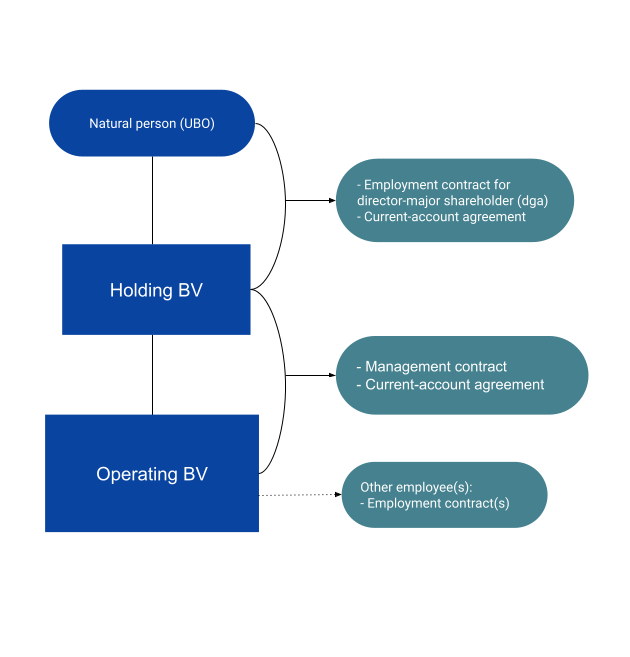
- Management agreement (between holding and operating BV)
- Employment contract (if anyone is employed by the company)
- GDPR privacy agreements (if the business deals with personal data)
- Many others!
2026 Update: Cross-Border Remote Work (NL/DE)
As of January 1, 2026, the 34-day rule is officially in effect. Employees living in Germany can work from home for up to 34 days per year without shifting their tax liability to Germany.
Note: Any session over 30 minutes counts as a full day. For structural remote work (1-2 days/week), a Shadow Payroll is still required. Contact us for a compliance check.
Insurance
Company insurance is not mandatory in the Netherlands. However, it is usually wise to take out insurance based on your company's activity and risk-profile. For example, you can take out liability insurance if you want to be sure that you are well protected from claims. These days there are even cyber security insurances to compensate damages from hackers or data leaks.
Business licenses in the Netherlands
There are no business licences need to start up a business in the Netherlands. However, certain industries require businesses to have additional licences, certificates or other paperwork in order. Examples are parts of the logistics industry, the pharma and biosciences industry and selling financial or insurance products.
Do I need a business license to run a business in the Netherlands?
In most cases, you will NOT need a business license to run a business in the Netherlands. There are a few exceptions, but most business activities do not require a license. The business licenses that are required in the Netherlands are mainly for certain types of businesses, such as restaurants. But also for specific industries such as transporting goods on the road, working with dangerous goods etc.
EORI
For trading companies that conduct import and/or export activities a EORI-number is often required. With the EORI number Customs identifies economic operators in the same way in all Member States. This yields efficiency benefits for those economic operators and customs alike. (EORI-number = Economic Operators Registration and Identification number). You can either create your own EORI number if you are declaring your own goods. However, most businesses importing goods use a freight forwarder (in Dutch: expediteur) or other third party to arrange the goods declaration. Find an overview of reliable providers in this freight forwarders database.
You can apply for an EORI-number at the website of the Dutch Tax and Customs Authorities (Belastingdienst). Furthermore, you can check the validity of an EORI number on this website.
IOSS
If you sell products to people in other European Union countries, you have to calculate the VAT for that country. This is usually the case with ecommerce. You also have to pay for and arrange the transport yourself. However, if the value of your imports is less than €150 per shipment, you can use the import scheme. This means that you don't have to declare VAT to the tax authorities of other EU countries. You will still have to report and pay this VAT every month, but you don't have to pay VAT when importing the goods. You do this through the IOSS portal of the country your business is registered in.
We can help you register and report in the IOSS portal in the Netherlands. Read more in our e-commerce and IOSS guide.
Registration for employers
If you are employing personnel for the first time, you must register as an employer with the Dutch Tax and Customs Administration. You will then receive the necessary forms to meet your payroll tax obligations.
Sector specific
Other special or industry specific permits and licenses may be required. For example for the food, transport or pharma industry. If you want to sell alcohol or tobacco, for example, you need to be aware of the specific rules.
Financial services licence (Wft)
The Financial Supervision Act (Wft) sets out the rules that financial service providers must follow. This includes companies that provide crypto services. The Dutch Central Bank (DNB) and the Netherlands Authority for the Financial Markets (AFM) are responsible for making sure these rules are followed. If you are thinking of starting up a financial service provider or fintech in the Netherlands, make sure to read this article.
Highly regulated industries
Beyond standard business licensing, certain industries face extensive regulatory frameworks that require coordination with multiple Dutch and EU authorities. We regularly work with clients in sectors like fuel wholesaling, pharmaceutical distribution, and chemical processing through our network of sector specialists.
For example, establishing fuel trading operations in Rotterdam involves:
- ACM notification for wholesale activities in petroleum products (mandatory even without physical storage)
- Excise duty registration with Dutch Customs for storage, transport, and trade of mineral oils
- Environmental permits from provincial authorities covering storage facilities, blending operations, and pollution controls
- EU compliance documentation for fuel quality standards and REACH chemical regulations
- Rotterdam Port Authority permits and tank storage agreements
- Product liability insurance and ADR transport compliance for dangerous goods
Timeline for full operational setup typically runs 6-12 months from initial company registration. Similar multi-layered requirements apply to pharmaceuticals, aviation services, and other regulated sectors. For these complex setups, we coordinate the standard company formation while our specialist partners handle the sector-specific licensing and compliance requirements.
European Responsible Person (ERP)
Regulatory compliance for non-EU cosmetic manufacturers.
Under EU Cosmetics Regulation (EC No 1223/2009), non-EU manufacturers must designate a legal or natural person within the EEA as a "Responsible Person." This entity ensures the product meets all safety standards and acts as the point of contact for regulatory agencies.
— Thomas Jaques, Founder & Advisor
Mandatory Setup Requirements
Setting up an ERP business involves ongoing financial commitments, including company maintenance and, in jurisdictions like the Netherlands and Ireland, non-EEA resident bond requirements. We assist with both the standard company formation and the coordination of specialized regulatory documentation required for this role.
What are the requirements for obtaining a business license in the Netherlands?
The requirements for obtaining a business license in the Netherlands vary depending on the type of business activity. However, you could be asked for documents as for example:
- proof of business identity (kvk number)
- proof of registration with the Dutch tax authorities (if applicable)
- proof of registration with the Social Security Agency (if applicable)
- business plan or feasibility study
How can I obtain a business license in the Netherlands?
If you want to obtain a business license in the Netherlands, you will need to contact the relevant government agency. The process for obtaining a business license can vary depending on the agency. Typically, you will need to submit an application and provide some documentation, such as your company's Articles of Association. You may also be required to attend an interview or take a test.
If you have any further questions, please contact us by filling out the form below.
Business contracts and legal compliance in the Netherlands
When doing business in the Netherlands, it is important to have a number of legal contracts in place. These contracts will help to protect your interests and ensure that your business is operating in accordance with Dutch law.
Some of the most important legal contracts for businesses in the Netherlands include:
Employment contracts: All employees in the Netherlands must have an employment contract. The contract should specify the terms and conditions of the employee's employment, including pay, hours, vacation, and benefits.
Contractor agreement: A service contract is a contract between a service provider and their client. The contract should specify the services that will be provided, as well as the price and payment terms.
Terms and conditions / terms of service: General terms and conditions are conditions that are intended to be part of multiple agreements. These terms and conditions are often referred to as the ‘small letters’. They describe conditions, such as delivery conditions and payment conditions but explicitly do not indicate the core of the agreement.
GDPR documents: for example a privacy policy, cookie statement and data processing agreement. Companies that process the personal data of EU citizens must comply with the GDPR unless they can demonstrate that they meet certain conditions specified in the GDPR. Failing to comply with the GDPR can result in significant fines.
Browse all relevant business contracts in the Netherlands in our legal catalogue.
Recruiting & Hiring Talent in the Netherlands
The Dutch job market is highly competitive and digitally driven. To attract top-tier talent in 2026, you need to navigate a landscape where LinkedIn is the absolute standard for professionals.
Thomas’ Compliance Tip: Dutch labor law is very protective. Be aware of the "Ketenregeling" (chain rule) which limits the number of fixed-term contracts you can offer before an employee must be given a permanent role. Always ensure your employment agreements are 100% compliant with the latest 2026 Dutch regulations.
Looking for a local hiring strategy?
Whether you need local employment contracts or want to explore Employer of Record (EOR) solutions to hire without an entity.
→ Get in touch for recruitment and payroll advice
Office, virtual office and real estate in the Netherlands
You will need a business address to register your company: either a residential address or a virtual office. Choose your provider carefully: some addresses are flagged by banks and Belastingdienst due to associations with questionable companies, which can block your VAT registration and banking applications. We can recommend reliable providers.
→ Read our full guide on business addresses and virtual offices
If you are looking for commercial real estate, most properties are listed on Fundainbusiness.
→ Read our guide on warehouses and 3PL fulfilment in the Netherlands
Funding & Growth
There are a number of ways to get funding for your Dutch company. One of the most popular methods is to raise money from private investors. Private investors can be individuals or companies that are interested in investing in your business. The Netherlands has a wide network of so-called Business Angels.
Another option is to seek funding from venture capitalists. Venture capitalists are investors who are willing to risk their money in order to help young or high-growth businesses grow. They typically invest in businesses that have the potential to generate a high return on investment.
You can also look for funding from government organizations or banks. Government organizations often provide funding to small businesses that have a strong track record and are considered to be high-growth businesses. Banks typically provide loans or lines of credit to businesses that can demonstrate that they have a sound business plan and are likely to repay the loan.
→Read more in our guide on financing your business in the Netherlands
How to get money into the BV?
There are essentially two ways to finance your new BV company: by selling/issueing shares (equity financing) or by receiving a loan (debt financing).
Equity financing
This type of financing is the process of raising capital through the sale/issue of shares.
There are two ways to perform equity funding:
1. Share issue
If your bv will issue shares, this happens using a notarial deed from a notary. The issueing of shares can occur when incorporating the new company, or for example when you want to add an extra shareholder without selling existing shares to the new shareholder. The amount being issued is called the Issued Share Capital. A BV usually has a very low issued capital. We usually recommend clients to issue 120 shares of 1 euro (or even 0,01 euro). This makes for a share capital of 120 euros. We choose 120 shares because this number is easy to divide by 2, 3, 4, 5, 6 and so on.This issued capital is not really important for the actual company valuation. If you buy shares from a BV, you have to "pay up" these shares because of your obligation to deposit. That actually means that you have to pay the value of the shares to the BV. If you have issued 120 shares of 1 euro, your shareholder will have to pay up 120 euro to a business bank account. The issued capital must be on the company's balance sheet, because it is part of the company's assets. Issueing shares as described above is NOT a common method to increase share capital for a BV company. A Share Premium Contribution (or in Dutch: "Agio") is the more logical way.
2. Share premium contribution (Agio)
This is most common way of equity funding of a BV company. This share premium is the amount paid up on the shares in excess of the nominal value of the shares. It costs much less time and less paperwork than issueing new shares. Share premium can be added to the company by transferring the amount to the company's bank account. Remember to include a suitable description of the payment (capital deposit by shareholder) so it is clear how the payment should be qualified.
Taxes & equity funding
Share capital and share premium are both considered to be part of the equity of a BV and have the same effect on taxation: in the Netherlands there is no tax on equity funding (of course the return on equity, dividend, may be subject to taxation).
More on taxation of Dutch companies in our tax guide.
Debt financing
In this scenario the BV is funded by giving a loan to the company. This loan can be granted by a person or another company. This loan must be in the company's interest. In order to comply with regulations from the tax authorities it It is very important that the loan is taken out under the usual business conditions. The most common loans are within a company structure. So for example a mother bv lending money to a daughter bv (or the other way around), or a main-shareholder/director lending money to the bv (or vice versa).
Debt funding & tax
There is a tax advantage to having a loan. If you lend money to your private limited company, the commercial interest that the private limited company pays to you as a business expense is deductible in corporation tax.
Ask our advisers
Starting a Dutch BV?
Hundreds of founders have used our Amsterdam office. We answer what Google can't:
- Which structure fits your situation
- Banks that accept foreign founders
- Real office vs virtual (what KVK accepts)
- Tax setup without the guesswork
Free 30-min call · Usually reply same day